Telemedicine has become mainstream in India since COVID-19. But with growth comes regulation. This guide covers all compliance requirements for telemedicine practice in India as of 2026.
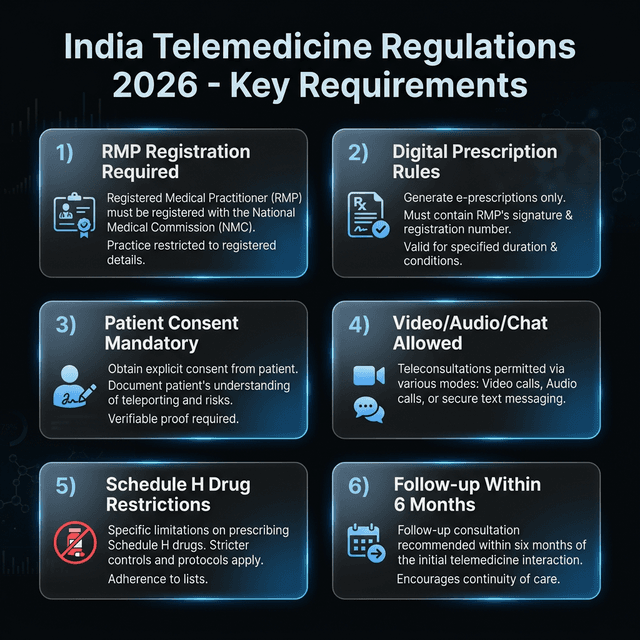
Key Regulatory Framework
- Telemedicine Practice Guidelines (TPG) 2020: Issued by MCI/NMC
- Digital Personal Data Protection Act 2023: Data privacy requirements
- ABDM Integration: National health ID compliance
- State Medical Council Rules: State-specific requirements
- Drug & Cosmetics Act: E-prescription of medications
Who Can Practice Telemedicine?
Only registered medical practitioners (RMPs) can provide telemedicine services:
India telemedicine market to reach $5.5 billion by 2027.
Teleconsultation adoption grew 500% since COVID-19.
- Valid registration with State Medical Council
- Must display registration number
- Must have completed telemedicine orientation (recommended)
- Cannot delegate consultation to non-RMPs
Patient Consent Requirements
Consent is Mandatory
- Explicit consent required before consultation
- Written/electronic consent must be documented
- Patient must be informed about limitations of telemedicine
- Right to refuse teleconsultation and seek in-person visit
- Consent for recording (if applicable)
Modes of Telemedicine
Three modes are recognized:
- Video: Preferred mode, closest to in-person consultation
- Audio: Acceptable with limitations on prescribing
- Text/Chat: Most limited, for follow-ups mainly
Prescribing Limitations
List O (Permitted via Telemedicine)
- OTC medications
- Common prescription drugs for stable conditions
- Refills for chronic conditions
- Standard antibiotics (with restrictions)
List A (First Consultation Only with Caution)
- Certain antibiotics
- Medicines requiring monitoring
- 7-day maximum on first consultation
Prohibited via Telemedicine
Cannot Prescribe
- Schedule X drugs (controlled substances)
- Narcotics and psychotropic substances
- Drugs causing dependence
- Drugs requiring physical examination
Documentation Requirements
Every teleconsultation must record:
- Patient identification (name, age, address, ABHA ID)
- Mode of consultation (video/audio/text)
- Date and time of consultation
- Chief complaint and history
- Examination findings (if any)
- Provisional diagnosis
- Treatment plan and prescription
- Advice for in-person consultation (if needed)
- Doctor's signature and registration number
Data Privacy (DPDP Act 2023)
Telemedicine platforms must comply with:
- Data Minimization: Collect only necessary data
- Purpose Limitation: Use data only for healthcare
- Storage Limitation: Delete when no longer needed
- Security: Encryption, access controls, audit logs
- Consent: Clear consent for data processing
- Rights: Patient right to access and delete data
Software Requirements
Compliant telemedicine software should have:
- ✅ End-to-end encrypted video calls
- ✅ Digital consent capture
- ✅ Integrated e-prescription
- ✅ Patient identification verification
- ✅ ABDM/ABHA integration
- ✅ Secure data storage
- ✅ Audit trails
- ✅ Recording capability (with consent)
ABDM Integration
Telemedicine platforms should integrate with ABDM for:
- ABHA ID verification
- Health record linking
- Consent-based record sharing
- E-prescription on national network
Common Compliance Mistakes
- ❌ Not obtaining documented consent
- ❌ Prescribing prohibited drugs via telemedicine
- ❌ Inadequate patient identification
- ❌ Missing documentation
- ❌ Using non-secure platforms (WhatsApp for consultations)
- ❌ Not displaying doctor credentials
Need Compliant Telemedicine Software?
Adrine's telemedicine module is built with all regulatory requirements in mind.
Get Free Demo